How to Install 16.25x21x4 Air Filters Correctly
TL;DR
A 16.25x21x4 air filter measures 16.25 x 21.00 x 3.63 inches. Unlike standard sizes, cut about half an inch under nominal, this odd-nominal size is cut to nominal on the face, so it fills the opening. Gaps, bowing, and whistling almost always come from the slot, a missing clip, or the depth difference, not a defective filter.
Key Takeaways
• A 16.25x21x4 filter measures 16.25 x 21.00 x 3.63 inches. The face sits at nominal; the depth is about three-eighths of an inch under four.
• Gap shape and filter efficiency both matter. A straight-through gap leaks more than one routed around a rack channel's bends, and the penalty grows as MERV rises.
• A whistle proves a leak, but silence proves nothing: a wide, low-velocity gap leaks just as much in silence.
• Gasket the slot, never the filter, which leaves every 90 days and takes any foam with it.
• Never trim or bend a filter to fit; a deformed frame can collapse into the blower.
What Is a 16.25x21x4 Air Filter, and What Does It Measure?
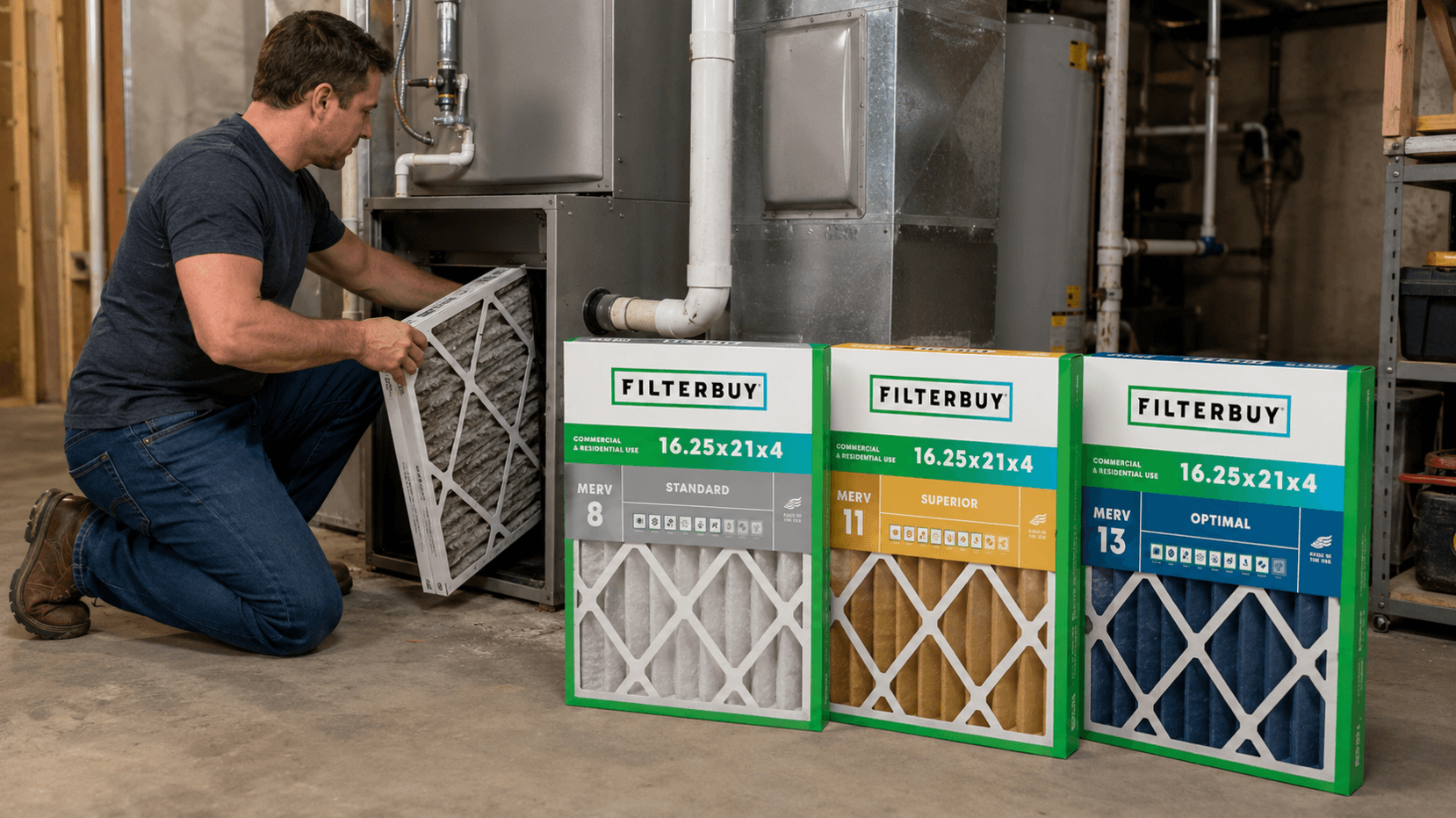
A 16.25x21x4 air filter is a four-inch-deep pleated air filter built for a return or media slot with a nominal opening of 16.25 by 21 inches. It is your furnace filter and AC filter at once, because a central system runs both through one blower and one slot.
Most sizes are cut about half an inch under nominal so they slide in without binding; a 16x25x4 typically measures 15.5 by 24.5 inches. Odd-nominal sizes are cut to nominal, so the filter fills the opening. That is why an out-of-square slot shows a gap here when it would look normal on a standard size.
Depth is the other half. “4 inch” is a category, not a measurement. Actual depth is 3.63 inches, so a filter in a true four-inch slot has about three-eighths of an inch of play. That is why an unsecured filter tips, rattles, or bows.
Why Is There a Gap Around My 16.25x21x4 Filter?
Measure the opening, not the old filter, then compare it against published actual dimensions. If your opening is wider than 16.25 or longer than 21.00 inches, the slot is the problem, and you need a rack or gasket rather than a different filter.
On August 25, 2026, we read published dimensions for nine listings: five sizes on Filterbuy's site and four of the same brand's listings at Target, Home Depot, Walmart, and Amazon. The undersizing is not uniform. A 16x24x1 lists an actual 15.38 x 23.38 x 0.75 inches, five-eighths under nominal. This size is the exception.
A quarter inch sounds trivial. Along a 21-inch edge, it is roughly five square inches of open channel, and every cubic foot through it is unfiltered.
Does a Small Gap Actually Matter?
Yes, and how much depends on the gap's shape and the filter's efficiency. Filter bypass has been modeled and validated on an apparatus built to ASHRAE Standard 52.2, across MERV 2 to 14 and gaps up to 32 millimeters. As efficiency rises, the same gap costs more, because a denser filter pushes more air toward the easy path around it. A gap with bends leaks less than a straight one, which is why a rack outperforms a bare slot. Gaps around a millimeter had little effect, so chase the visible gaps.
Where Your Filter Sits Changes the Diagnosis
A residential filter sits in one of two places. At the air handler, the slot is the leak path, and sealing it seals the system. At a return grille, a sealed grille still delivers unfiltered air if the return duct leaks downstream. Check slot depth too: Honeywell, Carrier, Bryant, and Aprilaire cabinets take five- and six-inch filters, where a 3.63-inch filter leaves nearly an inch and a half of play.
How Do I Install a 16.25x21x4 Filter So It Seals?
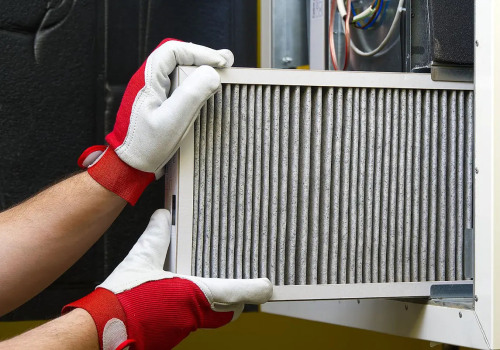
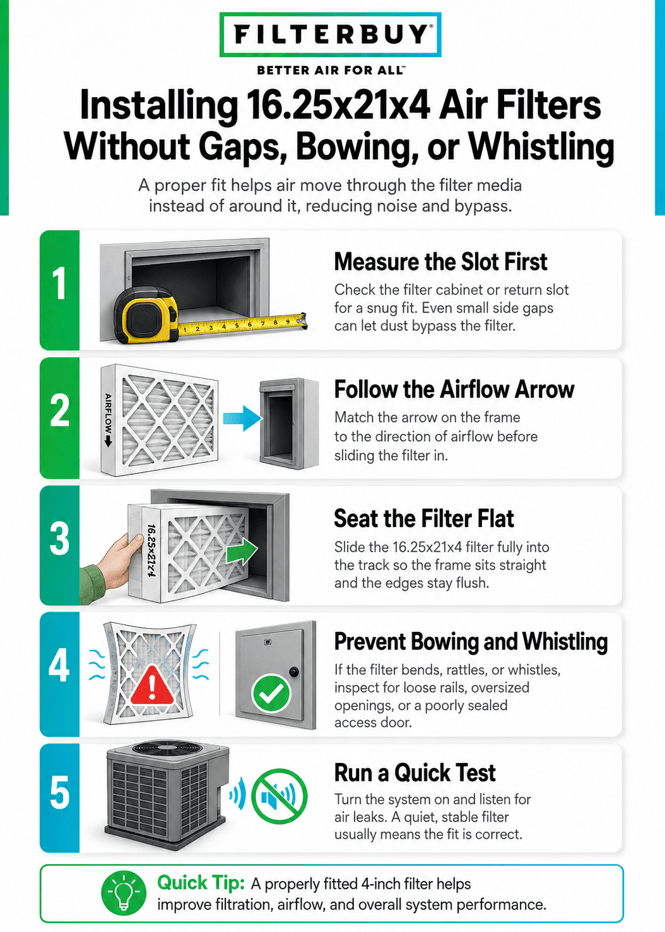
Turn the system off, seat the filter square with the arrow toward the blower, take up the depth play, then confirm the seal with the paper test.
1. Turn the system off at the thermostat.
2. Measure the opening in inches and write it inside the access door.
3. Point the airflow arrow toward the blower. On a four-inch filter, it is printed on the narrow frame edge, not the face, which is why it gets missed.
4. Slide, do not force, and seat it flush and square on all four edges. If you have to bend it, it is the wrong size.
5. Take up the depth play with the retaining clip or a foam strip inside the door.
6. Close the door and check the latch, since a door that does not seal is its own bypass path.
7. Run the system and listen. Silence means you found no loud leak, not that the slot is sealed.
Why Is My 16.25x21x4 Filter Bowing?
Bowing is blower pressure meeting unsupported media. Check the arrow first, since a reversed filter puts its support structure on the wrong side of the load. Then check loading, because a filter at the end of its life develops a much higher pressure drop. Then check the frame and retainer. A collapsed filter can be drawn into the blower.
Why Does My AC Whistle After I Change the Filter?
A whistle is high-velocity air forced through a narrow opening. Three sources cover nearly every case: a gap at the filter, a filter too restrictive for the system, or an unsealed access door. If it appeared the day you moved from MERV 8 to MERV 13, the upgrade did not create the leak. It revealed one already there.
Use the paper test: with the system running, hold a sheet of paper along the access door seam and filter track edges. Where the paper pulls, air is escaping. Mark each spot, shut the system down, and seal it.
How Do I Close the Gap Once I Find It?
Put the sealing material on the slot, track, or access door, never on the filter. Your filter is disposable and leaves every 90 days with any foam stuck to it; the track is permanent, so every future filter inherits the seal. Foam weatherstripping in 1/8 to 1/4 inch handles most gaps, a retaining clip takes up depth play, and an oversized slot needs a rack.
Never tape across the filter face, never stack two filters in a deep slot, and skip cloth duct tape, which fails with heat cycling.
The First Filter After a New Install Is a Special Case
Check it at 30 days, not 90. Construction and duct work leave drywall dust and metal shavings in a system that has never run, so the first filter loads far faster than the ones after it. The first month is also when a freshly handled slot is most likely to leak, and the cheapest time to have your installer fix it.
“Upgrading your filter can make your air worse if the slot leaks. A MERV 8 and a MERV 13 in a leaky slot are not equally handicapped: the MERV 13 is harder to pull air through, so more of the airstream chooses the gap.”
-The Filterbuy Team, U.S. air filter manufacturer
Essential Resources
Confirm actual dimensions before ordering: Filterbuy lists 16.25 x 21.00 x 3.63 inches for this size in MERV 8, 11, and 13, so you can check your slot against a published figure.
Source: Filterbuy’s 16.25x21x4 Air Filters
Find out what your filter can capture before paying for a higher rating, since this guide maps MERV ratings to particles like pollen, allergens, and smoke.
Source: EPA Guide to Air Cleaners in the Home
Read the body behind every MERV number, candid about where filtration helps and which technologies to treat with caution.
Source: ASHRAE Position Document on Filtration and Air Cleaning
Decide whether a MERV upgrade is worth it, from a health authority comparing HVAC filtration against portable cleaners and ventilation.
Source: American Lung Association on air cleaning
Rule out the rest of the system if the slot is sealed and the unit still runs long or loud, since airflow problems alone cut efficiency up to 15%.
Source: ENERGY STAR Maintenance Checklist
Supporting Statistics
• 88% of U.S. households used air conditioning in 2020, and two-thirds run a central system, where one slot filters every cubic foot of air in the house. A gap there is a whole-home problem.
Source: U.S. Energy Information Administration
• About 25 million Americans, 7.7% of the population, had asthma in 2021. The households most likely to run MERV 13 are the ones an unsealed slot penalizes hardest, since bypass costs high-efficiency filters the most.
Source: CDC Asthma Surveillance
• California, with one of the country's tightest residential energy codes, credits forced-air systems leaking under 6% of airflow at 25 Pa, so even there, tight is not zero. Berkeley Lab notes the cabinet itself is a barrier.
Source: Lawrence Berkeley National Laboratory
Final Thoughts
The industry has spent a decade selling homeowners up the MERV scale and almost no time teaching them to seal the slot. That ordering is backwards. A MERV 8 that seals beats a MERV 13 with a quarter-inch gap, and foam weatherstripping changes what you breathe more than the upgrade does.
A gap is not a defect. Odd-nominal slots were framed by hand, sometimes decades ago, so treat the slot as the variable rather than cycling through brands.
Next Steps
1. Measure the opening today and write the number inside the access door.
2. Compare it to published actual dimensions, not the box label.
3. Check the arrow direction and reverse it if wrong.
4. Run the paper test and mark every spot where the paper pulls.
5. Seal the track and door with adhesive foam, never the filter face.
6. Set a 90-day reminder, and call a technician if the whistle survives all of this.
Frequently Asked Questions
Q: Is 16.25x21x4 the same as 16x21x4?
A: No. A 16.25x21x4 measures 16.25 x 21.00 x 3.63 inches; a 16x21x4 measures 16.00 x 21.00 x 3.63 inches. That quarter inch is roughly five square inches of unfiltered channel.
Q: Which way should the arrow point?
A: Toward the blower, away from the return duct. On a four-inch filter, it is printed on the narrow frame edge rather than the face, which is why arrow errors cluster on thick filters.
Q: Can I use a smaller filter, or cut a larger one down?
A: No to both. A smaller air filter guarantees straight-through gaps on every edge, the worst configuration in bypass testing, and cutting the frame destroys the structure holding the media flat.
Q: How often should a 16.25x21x4 filter be replaced?
A: About every 90 days, sooner with pets, heavy dust, smoke, or asthma at home. Hold it to a light; if none passes through, it is past due.
Q: Which MERV rating should I run in this size?
A: It is made in MERV 8, 11, and 13, so the choice is yours. Seal the slot before climbing the scale, since a MERV 13 in a leaking slot underperforms a MERV 8 in a sealed one.
Ready to Stop the Whistle? Start With the Tape Measure
Measure your opening, match it to a filter's published actual dimensions instead of its nominal label, and seal whatever the paper test finds. Do that once, and the next ten filter changes are quiet five-minute jobs.
Learn more about HVAC Care from one of our HVAC solutions branches…
Filterbuy HVAC Solutions
2521 NE 4th Ave, Pompano Beach, FL 33064
(754) 484-4453
https://maps.app.goo.gl/JmWkEXya7uzuLzBh8