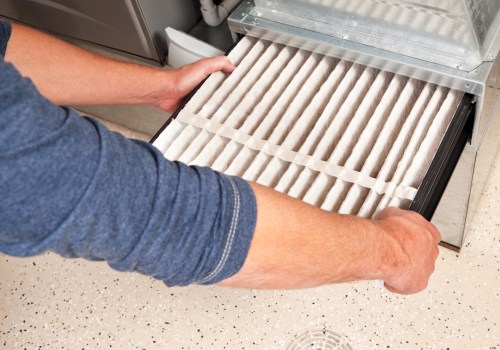
Your new HVAC system can become your biggest water damage risk if installation details get overlooked.
Customers tell us the same story repeatedly: a brand-new system starts leaking within months because the condensate drain wasn't pitched correctly or the drip pan sat slightly off-center. Kissimmee's 90%+ summer humidity pushes AC systems to produce gallons of condensate daily—far more than homeowners in drier climates ever deal with.
After years of working with Central Florida homeowners on indoor air quality, we've identified the specific failure points that cause post-installation water damage:
Condensate lines without proper P-trap installation
Secondary drain pans missing or incorrectly positioned
Humidity settings mismatched to local climate demands
Clogged drain lines from construction debris left during install
This guide shares what we've learned so you can catch problems before they escalate—whether your replacement happened last week or you're still planning.
Quick Answers
HVAC Replacement in Kissimmee
Kissimmee's subtropical climate creates unique demands that most HVAC installations don't account for.
What You Need to Know:
Systems produce 5–20 gallons of condensate daily during summer
Condensate drainage errors cause most post-installation water damage
Factory humidity settings don't work for Central Florida—manual adjustment to 45%–50% is essential
Permits are required by Florida law for all replacements
Before Installation:
Verify contractor holds valid Florida DBPR license
Confirm Manual J load calculations for proper sizing
Get condensate drain specifications and float switch installation in writing
After Installation:
Test float switch before installer leaves
Verify drain line slopes at minimum 1/4 inch per foot
Check drip pan weekly for first 90 days
Available Incentives:
KUA rebates: Up to $250 for qualifying heat pumps
Federal tax credit: 30% of costs up to $2,000 (expires December 31, 2025)
Bottom Line:
The homeowners who avoid water damage verify three things: drain pitch, float switch function, and humidity settings. A 15-minute inspection during installation prevents the $10,000 remediation calls we see too often in Central Florida.
Top Takeaways
Condensate drainage causes most post-installation water damage. Incorrect pitch, missing P-traps, and untested float switches create overflow problems within months—often before you notice.
Mold begins growing within 24–48 hours. Kissimmee's humidity accelerates this. By the time you see stains or smell odors, hidden damage has already spread.
One inch of water creates up to $25,000 in damage. A slow leak or single weekend overflow can require full remediation—far exceeding prevention costs.
Factory humidity settings don't work here. New systems need manual adjustment to 45%–50% indoor humidity. Otherwise, condensate production exceeds drain capacity.
15 minutes of inspection prevents $10,000 in repairs. Verify drain slope. Test your float switch. Check your drip pan. Do it within the first week.
Why Kissimmee HVAC Replacements Carry Higher Water Damage Risk
Central Florida's subtropical climate forces air conditioning systems to remove moisture continuously—often producing 5 to 20 gallons of condensate daily during summer. That volume demands flawless drainage from day one. Customers tell us the most common post-installation failures involve condensate lines pitched incorrectly, secondary drain pans positioned off-center, and float switches either missing or wired wrong.
Kissimmee's older homes compound the problem. Many were built before current HVAC efficiency standards existed, forcing installers to improvise drain routing when retrofitting high-capacity systems into tight spaces. These workarounds often fail under heavy condensate loads, sending water into ceilings and walls within weeks of installation.
The fix starts with verification. Confirm your drain line slopes at least 1/4 inch per foot, check that a P-trap is installed on negative pressure systems, and test your float switch to ensure it shuts down the unit before overflow occurs. A 15-minute inspection after installation prevents the $10,000 mold remediation bills we've seen too many homeowners face.
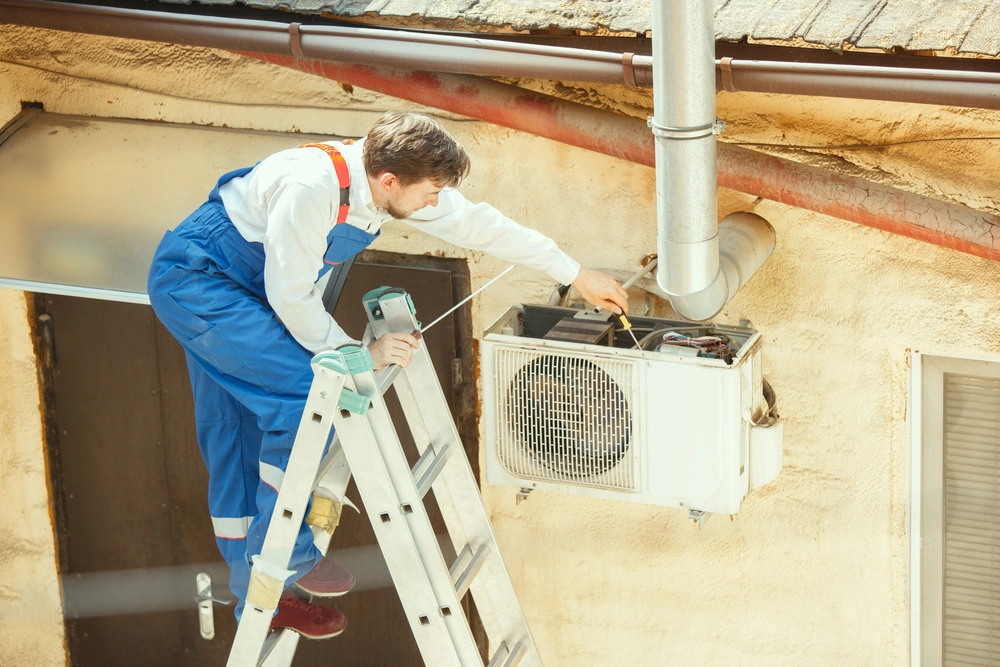
"Nine times out of ten, the water damage calls we get within six months of an HVAC replacement trace back to the condensate drain system—either the pitch was off, the P-trap was skipped, or nobody tested the float switch before leaving the job site."
Essential Resources for HVAC Replacement in Kissimmee
Customers tell us the research phase feels overwhelming. These seven resources help you verify credentials, maximize savings, and avoid the mistakes we see Central Florida homeowners make most often.
Verify Your Contractor's License Before Signing
We've heard too many stories about unlicensed installers disappearing after a problem surfaces. Florida DBPR License Lookup confirms any HVAC contractor holds valid state certification—search by name or license number to check active status and complaint history before you commit.
https://www.myfloridalicense.com/wl11.asp
Claim Up to $450 in Local Utility Rebates
Many Kissimmee homeowners don't realize these rebates exist until after installation. Kissimmee Utility Authority offers $250 for qualifying heat pump installations plus 50% of duct repair costs (up to $200). Work must be completed by a state-licensed HVAC contractor.
https://kua.com/energy-conservation/rebates/
Find Tax Credit-Eligible Equipment
After helping customers navigate efficiency requirements across Central Florida, we know how confusing equipment ratings can be. Energy Star Product Finder identifies air conditioners and heat pumps meeting federal efficiency requirements—listed products qualify for the 25C tax credit and exceed minimum performance standards.
https://www.energystar.gov/productfinder/
Save Up to $2,000 on Federal Taxes
This credit expires December 31, 2025—and customers consistently tell us they wish they'd known sooner. IRS Energy Efficient Home Improvement Credit covers 30% of qualifying heat pump costs. Equipment must meet CEE highest efficiency tier specifications.
https://www.irs.gov/credits-deductions/energy-efficient-home-improvement-credit
Confirm Your Installation Meets Code
Skipped permits create problems that surface during home sales or insurance claims. Osceola County Building Permits portal lets you verify permit status and inspection results. Florida law requires permits for all HVAC replacements in Kissimmee—your contractor should pull these on your behalf.
https://www.osceola.org/Doing-Business/Building-and-Permits/Permit-Information
Validate Your System's Performance Ratings
Mismatched components are one of the most common issues we see in post-installation complaints. AHRI Directory of Certified Product Performance confirms indoor and outdoor units are properly matched. Request the AHRI reference number from your installer to verify advertised efficiency ratings.
Check Contractor Reviews and Complaints
A few minutes of research prevents months of frustration. Better Business Bureau Central Florida provides ratings, customer reviews, and accreditation status. KUA Participating Contractors must maintain active BBB membership as a qualification requirement.
https://www.bbb.org/local-bbb/bbb-serving-central-florida
Supporting Statistics
These numbers from federal agencies confirm what we see repeatedly in Central Florida homes.
One Inch of Water Creates $25,000 in Damage
FEMA calculates that just one inch of standing water causes up to $25,000 in home damage.
Customers tell us they assumed a slow condensate leak was minor—until they discovered:
Saturated subfloors requiring full replacement
Warped baseboards and door frames
Ruined insulation hidden behind walls
Damaged drywall spreading beyond the original leak site
A single weekend away with the AC running can produce enough condensate overflow to reach that threshold.
https://www.fema.gov/flood-insurance
Mold Takes Hold Before You See It
The EPA confirms mold begins growing on wet materials within 24 to 48 hours.
After working with Central Florida homeowners, we've learned:
By the time you smell mold, growth has already spread beyond the visible area
Ceiling stains indicate weeks of hidden moisture accumulation
Kissimmee's humidity accelerates this timeline significantly
What takes three days in a drier climate happens here in one.
https://www.epa.gov/mold/brief-guide-mold-moisture-and-your-home
Humidity Settings Make or Break Your System
EPA guidelines recommend indoor humidity between 30% and 50% to prevent mold and dust mite growth.
We consistently see new systems installed with factory-default settings that ignore Kissimmee's 90%+ summer humidity. The result:
Efficient equipment running ineffectively
Condensate production exceeding drain capacity
Overflow problems within the first cooling season
Proper humidity configuration during installation prevents these failures.
https://www.epa.gov/mold/mold-course-chapter-2
Final Thought
Kissimmee's climate demands more from HVAC systems than most regions—and more attention to installation details that contractors in drier states rarely consider.
The pattern we see is consistent:
Homeowners invest thousands expecting improved comfort and lower bills
Six months later, ceiling stains, musty odors, or remediation estimates appear
The system itself works fine
The condensate drain was pitched wrong, the float switch wasn't tested, or humidity settings stayed on factory defaults
Our Take
After years of helping Central Florida homeowners navigate indoor air quality issues, we believe the 48-hour window after installation matters more than most people realize.
The contractors leave. The permit closes. The warranty paperwork goes in a drawer.
Meanwhile, hidden problems develop:
A slow drip behind a wall nobody can see
An undersized drain line handling more condensate than designed
Issues that won't surface for weeks—sometimes months
What We Recommend
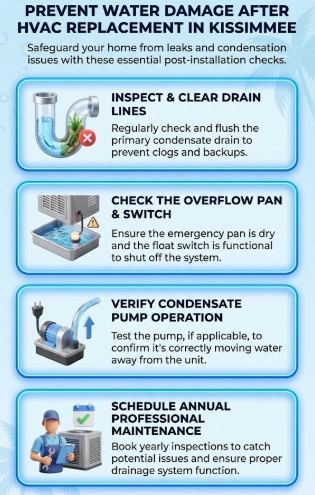
Request a walkthrough of your condensate drain system before the installer leaves
Verify the float switch shuts down your system before overflow occurs
Confirm humidity settings match Kissimmee's climate—not northern factory defaults
Check the drip pan and visible drain lines weekly for the first 90 days
Document everything with photos in case warranty claims arise later
Bottom Line
The homeowners who avoid water damage aren't lucky. They're informed.
They ask questions during installation, verify the details that matter, and catch small problems before they become expensive ones.
A 15-minute inspection today prevents the $10,000 mold remediation call six months from now.
Next Steps
Take these actions to protect your investment and prevent the water damage issues we see most often.
If Your System Was Recently Installed
Locate your condensate drain line and confirm it slopes downward the entire length
Test your float switch to verify it stops the system before overflow
Check your drip pan for standing water, rust stains, or debris
Verify humidity settings target 45%–50%, not factory defaults
Save your permit number, AHRI certificate, and installer contact in one place
If You're Still Planning Your Replacement
Request Manual J load calculations for proper sizing
Ask about condensate drain pitch and P-trap installation
Confirm a secondary drain pan if your air handler sits above living space
Verify the installer will pull permits and schedule inspections
Get float switch installation in writing before signing
Ongoing Maintenance
Monthly:
Pour 1/4 cup white vinegar down the condensate drain
Inspect secondary drain pan for standing water
Every 90 Days:
Check drain lines for sagging or disconnection
Monitor indoor humidity during peak cooling
Annually:
Schedule professional drain line clearing
Verify refrigerant charge and coil condition
Warning Signs—Call a Professional Immediately
Water stains on ceilings or walls near air handler
Musty odors from supply vents or return registers
Dripping sounds when system cycles off
Visible moisture or algae at drain line exit
Humidity readings above 55% despite system running
FAQ on “HVAC Replacement in Kissimmee”
Q: Do I need a permit for HVAC replacement in Kissimmee?
A: Yes. Florida law requires permits for all HVAC installations and replacements.
What we've seen when homeowners skip this step:
Complications during home sales
Insurance claim denials
Voided manufacturer warranties
Missed inspections that catch drainage errors
Your contractor should pull the permit through Osceola County or the City of Kissimmee. Never hire a contractor who offers to work "off permit."
Q: How long does an HVAC replacement take in Kissimmee?
A: Most residential replacements take one day. Expect two days if your home requires:
Ductwork modifications
Drain line rerouting
Attic air handler repositioning
Here's what we've learned: installers who finish fastest often skip critical steps. A thorough installation includes:
Testing condensate drainage
Verifying float switch operation
Adjusting humidity settings for Kissimmee's climate
An extra hour on these details saves thousands in potential water damage.
Q: What SEER rating should I choose for Kissimmee's climate?
A: We recommend 16 SEER2 or higher for Kissimmee homes.
Why efficiency rating matters here:
Higher SEER systems run longer at lower capacity
Longer run times pull more moisture from indoor air
Better humidity removal prevents mold growth
Financial incentives at this threshold:
KUA rebates up to $250
Federal tax credits up to $2,000 (expires December 31, 2025)
Q: Why is my new HVAC system leaking water?
A: This is the most common call we hear within six months of installation.
New system leaks almost always trace back to:
Improper condensate drain pitch
Missing or incorrectly installed P-trap
Debris left in the line during installation
Kissimmee's humidity pushes AC systems to produce 5–20 gallons of condensate daily during summer. Even small drainage errors create visible leaks within weeks.
Contact your installer immediately. Most warranties cover drainage issues if reported promptly.
Q: How often should I maintain my HVAC system in Kissimmee?
A: Schedule professional maintenance twice yearly—before cooling season and before heating season.
What most maintenance guides miss: Kissimmee's humidity demands monthly attention to your condensate system.
Monthly:
Pour 1/4 cup white vinegar down the drain
Every 90 Days:
Check drip pan for standing water
Inspect visible drain lines for sagging
The homeowners who avoid water damage adapt their routine to Central Florida's conditions—not generic schedules written for northern climates.
Here is the nearest branch location serving the Palm City FL area…
Filterbuy HVAC Solutions - West Palm Beach FL
1655 Palm Beach Lakes Blvd ste 1005, West Palm Beach, FL 33401
(561) 448-3760